Ideal City
by Luis Gottardi, in Ojodepez Magazine

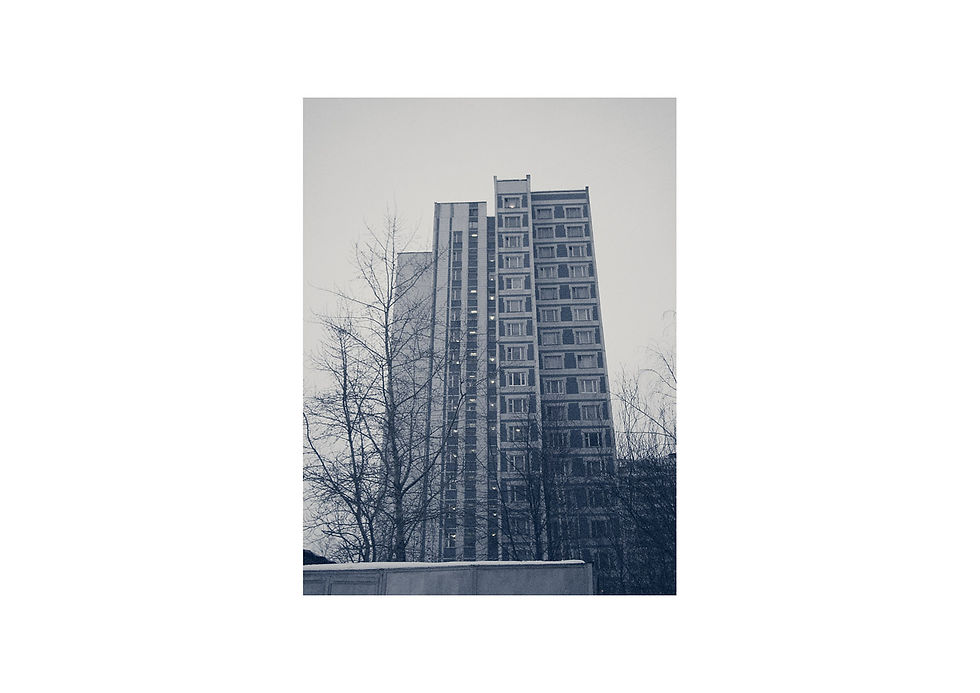
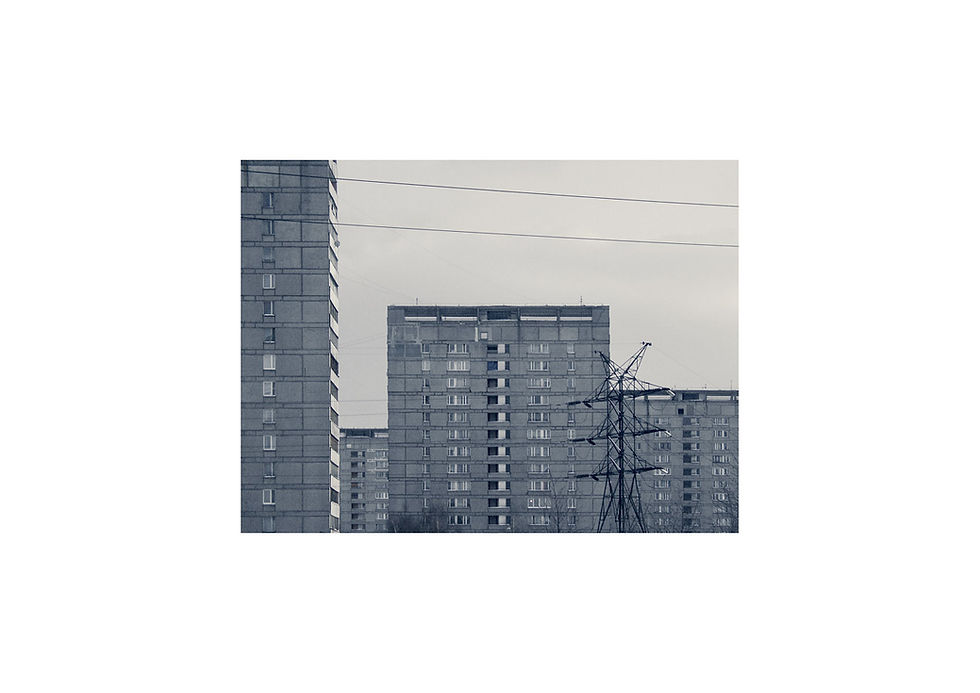
The clusters of large apartment blocks in Moscow, which form the central subject of this series by Bee Flowers, are called 'microrayons'. Sharing design & historical DNA with public housing and high-priced, free-market condominiums in many parts of the world, microrayons became a universal form of housing in Russia. Land, being government-owned, available, and plentiful, resulted in these units sprawling radially from the core of the city to its periphery. The architecture and design was not due to costs or other market pressures, but from an idealistic Communist vision of what a city and nation could be.

This Utopian vision of a functional cosmopolitan worker's collective would be facilitated, in part, by design, materials, and layout of the housing. Homogeneity in design was supposed to eliminate competition and individuality, creating a viable alternative to Capitalism. Instead, it resulted in density increasing as one neared the edges of Moscow, left dead industrial areas nearer to the core, caused high transportation/ supply/ maintenance costs and alienation. The early five-story version of these structures were referred to as 'khrushchovkas', derived from Nikita Khrushchev who initiated their construction around 1954, having released thousands of political prisoners from the Stalinist era, creating an instant housing crisis in Moscow.

As the Industrial Age progressed in the 1800's, the great migration from agricultural communities to the cities accelerated. Owners soon realized the value of skilled workers and began providing housing for them near the factories. Robert Owen built housing for the workers at his cotton mill in New Lanark, Scotland, around 1800. In 1817, Owen made a proposal to the House of Commons in England to build large apartment blocks in the form of squares, as "functional communities". Later, he would originate Socialism, and start a community in New Harmony, Indiana, that failed after a few years. In 1849, his son, Robert Dale Owen, published his seminal book Hints on Public Architecture. In 1851, Titus Salt, an industrialist in the town of Saltaire, in Yorkshire, England, was the first to employ architects, Lockwood and Mason, to design worker's housing, in the form of small Italianate villas. In NY, and most other cities, public housing meant the tenements that Jacob Riis photographed in the late 1880's, and that still skirt the edges of many major cities around the world.

Karl Ehn oversaw the rise of massive socialist worker's housing in Vienna from 1919 to 1933 referred to as 'worker's fortresses'. From 1919-1930 there was a flowering of Revolutionary Soviet Modernist architecture: Konstantin Melnikov and his landmark Rusakov Club, and Ilia Golosov's Zuev Club for Tram Workers. In 1928-30, Russian Moisei Ginzburg designed the Narkomfin building to house workers for the Finance Commisariat. By 1932, individual architectural practice was abolished in the USSR. The influence of Ginzburg's Narkomfin design on Le Corbusier, who saw it on a visit to Moscow, can be seen in his subsequent early experiments with public housing in Russia, Holland, and Austria. These efforts culminated with L'Unite' d' Habitation, the prototype for the large Soviet structures comprising the microrayons. The first Unite' was built in Marseilles in 1952. Three others followed in Nantes, Brie-en-Foret, and Berlin. They were envisioned as modular, self-sufficient neighborhoods.


Most photography of this type of housing has been documentation of either the architecture, or of the residents, as in Bruce Davidson's 100 E. St, (1970), a documentary work in NYC reminiscent of the Photo League. Lewis Baltz's work has dealt with industry and housing advancing into open USA landscapes since the 1970's. Robert Adams' work from the same era has focused on the encroachment of development and land use in the American West, as if covering the aftermath of a lost war on Nature and Humanity. The exteriors of the buildings began showing up in the art world sporadically in the mid-to-late '90s, mostly from the so-called "Struffsky" or Dusseldorf School.

Andreas Gursky did his famous "Montparnasse, Paris, 1993". A singlet on the topic, in which he shows a block of over a thousand apartments in a very flattened, formal, Mondriannesque space from his usual high, omniscient viewpoint and large-scale print.

Thomas Struth delved deeper into the subject with work in Shanghai and Europe in some ways similar to Gursky's, though far less operatic and from a variety of viewpoints. Gabriele Basilico used the architecture of Beirut as a metaphor for the resilience of its residents in the early 2000's.

Like the Struffsky-ites, Bee abandoned chiaroscuro in Megastructure. He chose a severely-restricted almost monochromatic palette and range of tones, reminiscent of the painting technique known as grissaille, popular in Northern Europe in the 15th & 16th centuries. The occassional bit of red stands out. These faintly glowing embers among the ashen grays and pale chromatics are like distant candles flickering in the gloom.


There are elegiac strains in these pictures of gigantic, uniform monuments to a failed idea, marking the confluence and passing of Modernism and Communism, anxious, with emotional shadows and only traces of the nostalgia for the Soviet era found currently in Postmodern Russian art. The artist brings us a studied contemplation hinged on largely colorless, cold, drab, austerely gray cosmopolitan outposts, looking more like fortifications than homes, simultaneously longing for, and contemptuous of, the recent past and the failure of its passionate ideology.

Most, if not all, of Megastructure is seen from the ground, giving the work a more egalitarian, humane, natural-looking, involved, inquisitive & less illustrative feel than Gursky's. The microrayons look oppressive, anonymously modular, everpresent, and enormous... nothing like the architectural maquette-like look of Gursky's building.

The artist's formal consistency gives an uneasy noir feel to these communities, one of isolation, insulation, and other social outcomes of the microrayons. Winter is an endtime season, a period of transition, reflection, rethinking recent history, here stripped of all pretense.

People are anonymous, tiny figures, all bundled up, threading their way between the snowbanks along wet, possibly muddy walkways as they come and go. In most pictures where they are found, they are not discernable as individuals, and often alone or in small groups. Only in one picture do we see people engaged in obvious leisure time activity, an image of children playing in the snow.

These pictures show the buildings, both as individual units and in clusters, and the context in which they exist: service areas, roads, and highways ringing Moscow sometimes in close proximity to these structures with their half-shell noise barriers, looking more like a lyrically organic visual shield against the ubiquitous microrayon.

The infrastructure around these buildings is carefully included: There are small nondescript buildings that look like shops; others are probably management, security, heating units, or electrical stations, roads, bus stops and a bus. Here and there, a smokestack punctures the horizon. We even see ground broken, awaiting the construction of another microrayon.


Megastructure is divided into five chapters. The first dawns with fuzzy, mirage-like images, bringing to mind Sugimoto's 'Architecture', opening up to revelatory reflections and the distant microrayons through train or bus windows, as if the viewer is arriving. Treelines with the apartment buildings in the background, snow piled up in the foreground. Ground broken for the construction of a new structure. Access roads leading to the complexes. A feeling of an idea(l) taking shape as one approaches. A poetic, instead of objective, approach.

The Second Chapter, comprised of single images, brings us closer still to the clusters. Here there is exploration of construction sites, roads, infrastructure, people coming and going, even billboards. We learn what is around these buildings - their context.

In Chapter Three lie multiple, interrelated images, very interlude-like, some receding and fuzzy. Transportation in the form of roads, people waiting for the bus or train, gas pumps, a row of semi truck-trailers. A building towers majestically in uncorrected perspective. A bus. Some lights on in the buildings in the distance: a sign of life.

The Fourth Chapter leaves the artifacts of stitching various frames together and correcting perspective in a panorama digitally. Self-referential to the process, here the ersatz veracity is deconstructed yet simultaneously heightened by including entire microrayons, and connecting neighboring ones. The enormity of the microrayons becomes readily apparent. More undeveloped and developed land is shown, colors become more noticeable, and the tectonics between the snow and buildings is clearer. Construction cranes rise like skeletal beings above the land. The forest of structures is revealed.

In closing, Chapter Five, at dusk, brings color back. Rich darkening blues intensify as line softens and softly blurs. Lights are on in the units, signs of life inside. In the last picture, as we depart, we see one last blurry shimmering apartment block through the window, much like we did at the beginning.


Spiritually, there is a similarity to James Joyce's Ulysses. This series could be seen as taking place in one day, marked by arrival in a bus or train, followed by a prolonged, labyrinthian walk around the buildings, and departure in the evening. The buildings, like the people in them, look the same, but the philosophy and the times that shaped, enveloped, and guided them is now gone. Time and ideals expire, paradigms shift, and the spirit lags under inertia until it redefines itself, adapting and coming to terms with the present.

The repeating representations of these units, looking like Super-Sized apiaries clustered around snowy, barren landscapes, blurs the line between utility and aesthetics. It would be easy to construe Megastructure as a Germanic, Becher-esque typology of microrayons & infrastructure en situ, but it is not anything of the kind.

Bee's appproach rejects the operatic, analytical, omniscient, explanatory viewpoint for a more direct poesis, a dialectic between the ideals of communism and its outcome. He has expanded our experiential menu via successive approximations, similar to movements in classical music- not by serving us on a silver platter, but by being our guide, taking us past snow-banked roads and fields, through a forest of manifestations of an ideal.

It is always Winter in Megastructure. Snow-covered ground, numbing cold, the dark tracery of tree-limbs and grey skies predominate in these pictures, a still and sparsely populated frozen landscape punctuated by these huge blocks of apartments, whose moment has come and gone, the artist shifting and redacting their codification as they become recontextualized in the Post- Soviet era, from the status quo to a monumental requiem for an ideal.

--- Luis Gottardi


Postscript -- Moscow Mayor Mr. Luzhkov has announced that 200 new high-rises will be built in the City in the next few years. Five-story block buildings are scheduled to come down. Eight thousand apartments, encompassing 32 million square feet, will be built per year.