Megastructure
Moscow's Unsettled Minimalism


Bill Levitt, the father of mass-produced American suburbia, once claimed that no man who owns his own house can be a communist. Judging by the urban landscape they built, the Soviets seemed to agree - only in reverse. In the ideological climate of the day, capitalist cities were read as the chaotic outcome of exploitative societies, and the stark divide between centre and periphery as a built expression of inequality. Socialist architects were therefore charged with inventing a new urban form: a city structurally aligned with a socialist way of life.
This new type would help replace individualism and domestic privatism with collectivism, and would, in principle, dissolve social segregation. Vast bodies of research, norms, and standards were devoted to typified housing schemes - down to matching furniture, household equipment, and much else besides. Today, Russian urban space consists largely of concrete panel buildings drawn from only a few standard types spread across the country, lending cities (and even interiors) a striking sameness.


Cities expanded outwards from their centres in planned thrusts of construction. As technology permitted ever taller structures, the highest buildings often rose at the very edge, so that the city ended not by tapering off but by asserting itself. There is no gentle gradient here, no suburban in-between. In the absence of free enterprise, sprawl in the capitalist sense was impossible. At the urban boundary, the landscape shifts abruptly, almost violently.
Beyond the final block lies farmland, or industry, or (most often) something in between: what I can only think of as nothing. Past the last slabs begins a void where the soil is barren except for hardy shrubs and marsh grass. The ground is punctured and scarred by abandoned earthworks, strewn with nondescript waste. Dogs growl at your heels; watchmen guarding the last outposts take your measure with wary suspicion. This is a suspended condition awaiting definition: a post-industrial brownfield that can feel, at the same time, like a pre-urban state - land touched but not developed, approached but not claimed for any final purpose. A kind of no-man’s-land separating reinforced-concrete civilisation from nature: a hinge between the constructed and the organic, a frontier of temporary indecision with faint symbolic ambitions.


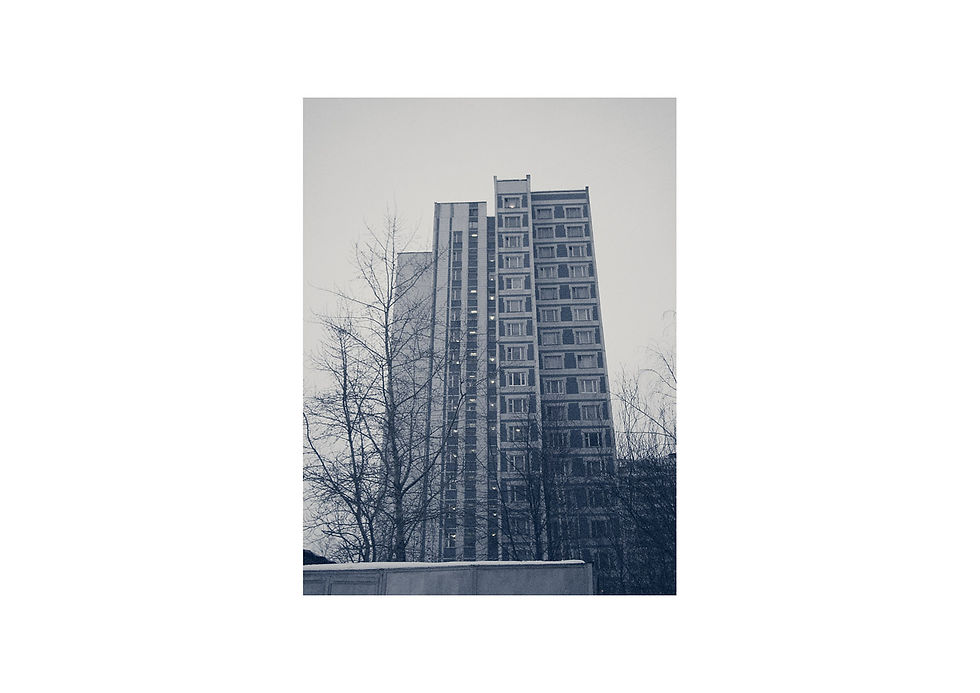
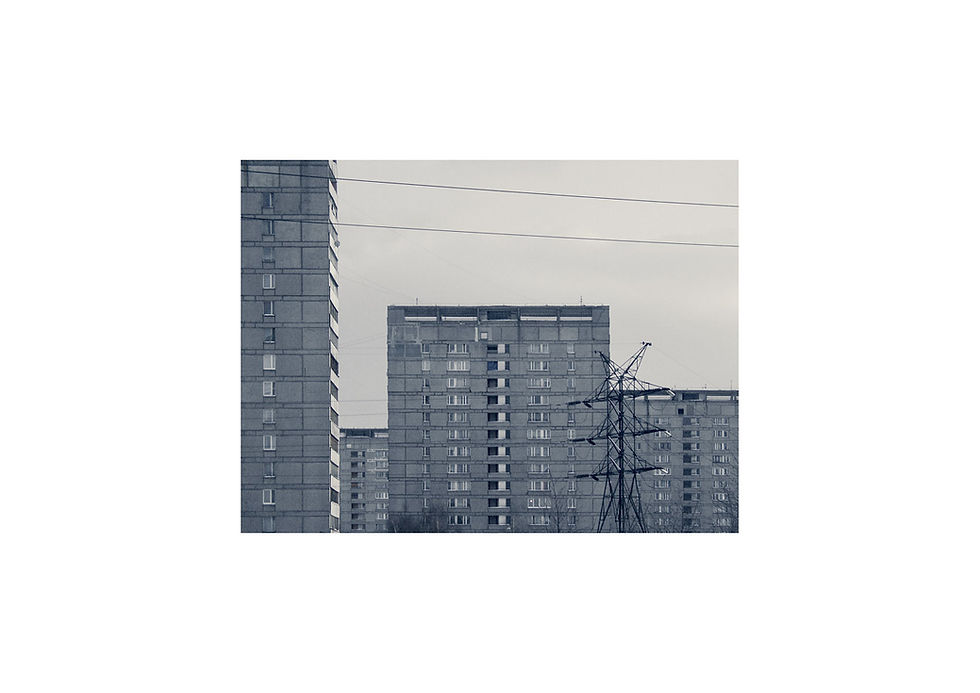


I went out to investigate that zone where concrete tears into earth, then wandered back through the micro-districts that generate this pattern of scar tissue. Only then did I become fully conscious of the city I found myself in - and fell under its spell: the monotony of shape and colour; the stark revocation of individual expression; the Modernist street-phobia - that refusal to grant the street its social value as a primary element of urban structure. I found myself alternately puzzled and exhilarated by the odd rhythms of housing blocks scattered in ways that never quite resolve into streets or boulevards, never cohere into a legible urban idea. The whole began to look like the product of a creative system that accommodates controlled chance and even failure. In the end, I surrendered to the Soviet city’s unsettled minimalism.


